
Predicting observed Gaia population#
Once you’ve computed the photometry of your sources it’s nice and simple to predict the portion of your population that observable by Gaia. Let’s talk about how to do it!
Learning Goals#
By the end of this tutorial you should know how to:
Apply the Gaia empirical selection function to your source photometry in a
Population
Beware - extra dependencies required here!
You’ll need to have installed the extra dependencies of cogsworth to make predictions for Gaia. Check out the installation page for more details on how to do this! (You’ll probably just need to run pip install cogsworth[extras])
[1]:
import cogsworth
import matplotlib.pyplot as plt
import numpy as np
import pandas as pd
import astropy.units as u
[2]:
# this all just makes plots look nice
%config InlineBackend.figure_format = 'retina'

plt.rc('font', family='serif')
plt.rcParams['text.usetex'] = False
fs = 24

# update various fontsizes to match
params = {'figure.figsize': (12, 8),
          'legend.fontsize': fs,
          'axes.labelsize': fs,
          'xtick.labelsize': 0.9 * fs,
          'ytick.labelsize': 0.9 * fs,
          'axes.linewidth': 1.1,
          'xtick.major.size': 7,
          'xtick.minor.size': 4,
          'ytick.major.size': 7,
          'ytick.minor.size': 4}
plt.rcParams.update(params)
pd.options.display.max_columns = 999
Gaia observability#
cogsworth uses the gaiaunlimited package to determine the Gaia observability of each source. The Gaia empirical selection gives the limiting magnitude for a given position on the sky and thus provides a more accurate estimate than a simple magnitude cut.
Once you’ve calculated the photometry (explained in the previous tutorial), working out which binaries are observable with Gaia is a simple function call away!
[3]:
p = cogsworth.pop.Population(1000, use_default_BSE_settings=True)
p.create_population()
p.get_observables(filters=["Gaia_G_EDR3"], ignore_extinction=True,
                  assume_mw_galactocentric=True, silence_bounds_warning=True)
Run for 1000 binaries
Sampled 1335 binaries
[8e-03s] Sample initial binaries
[0.4s] Evolve binaries (run COSMIC)
Integrating orbits: 100%|██████████| 1341/1341 [00:01<00:00, 747.51it/s]
[2.6s] Integrate galactic orbits (run gala)
Overall: 3.0s
[3]:
| Av_1 | Av_2 | M_abs_1 | m_app_1 | M_abs_2 | m_app_2 | Gaia_G_EDR3_app_1 | Gaia_G_EDR3_app_2 | teff_obs | log_g_obs | secondary_brighter | Gaia_G_EDR3_abs_1 | Gaia_G_EDR3_abs_2 | |
|---|---|---|---|---|---|---|---|---|---|---|---|---|---|
| 0 | 0.0 | 0.0 | 16.582948 | 34.693657 | inf | inf | 34.502030 | inf | 3.468207e+03 | 8.085400 | False | 16.391321 | inf |
| 1 | 0.0 | 0.0 | 8.492725 | 23.197668 | 8.595930 | 23.300873 | 23.223452 | inf | 3.697819e+03 | 4.832206 | False | 8.518510 | inf |
| 2 | 0.0 | 0.0 | 7.665989 | 22.561875 | 10.250501 | 25.146387 | 22.984300 | inf | 3.925716e+03 | 4.710860 | False | 8.088414 | inf |
| 3 | 0.0 | 0.0 | inf | inf | inf | inf | inf | inf | 1.833452e+06 | -inf | False | inf | inf |
| 4 | 0.0 | 0.0 | 10.191509 | 26.959628 | 10.728453 | 27.496572 | 27.004620 | inf | 3.630227e+03 | 5.071367 | False | 10.236500 | inf |
| ... | ... | ... | ... | ... | ... | ... | ... | ... | ... | ... | ... | ... | ... |
| 1330 | 0.0 | 0.0 | 9.165582 | 23.659866 | 9.471239 | 23.965523 | 23.740457 | inf | 3.614846e+03 | 4.924914 | False | 9.246173 | inf |
| 1331 | 0.0 | 0.0 | 4.753922 | 19.361943 | 10.944999 | 25.553021 | 19.240455 | inf | 5.758851e+03 | 4.431650 | False | 4.632433 | inf |
| 1332 | 0.0 | 0.0 | 8.515085 | 23.094082 | 8.815338 | 23.394335 | 23.112466 | inf | 3.707657e+03 | 4.836532 | False | 8.533468 | inf |
| 1333 | 0.0 | 0.0 | 9.588492 | 24.670505 | 11.342224 | 26.424237 | 25.232403 | inf | 3.555713e+03 | 4.969436 | False | 10.150390 | inf |
| 1334 | 0.0 | 0.0 | 15.181072 | 29.654803 | 9.152450 | 23.626181 | 24.162421 | inf | 3.687156e+03 | 4.939407 | True | 9.688690 | inf |
1335 rows × 13 columns
get_gaia_observed_bin_nums() return the bin_num s that correspond to the observable systems in two lists: one for bound binaries and disrupted primaries, and the other for disrupted secondaries.
Note that we need to specify the ra and dec for this function. In our case, let’s allow cogsworth to assume a Milky Way galactocentric frame for systems and automatically get their positions on the sky.
[4]:
bound_prim_obs_nums, sec_obs_nums = p.get_gaia_observed_bin_nums(
    ra='auto', dec='auto'
)
Warning: the archive is unstable and we are working to resolve this issue. In case of questions, please contact the Gaia helpdesk: https://www.cosmos.esa.int/web/gaia/gaia-helpdesk
/Users/twagg/miniforge3/envs/cogsworth/lib/python3.11/site-packages/gaiaunlimited/selectionfunctions/apogee.py:7: UserWarning: pkg_resources is deprecated as an API. See https://setuptools.pypa.io/en/latest/pkg_resources.html. The pkg_resources package is slated for removal as early as 2025-11-30. Refrain from using this package or pin to Setuptools<81.
  import pkg_resources
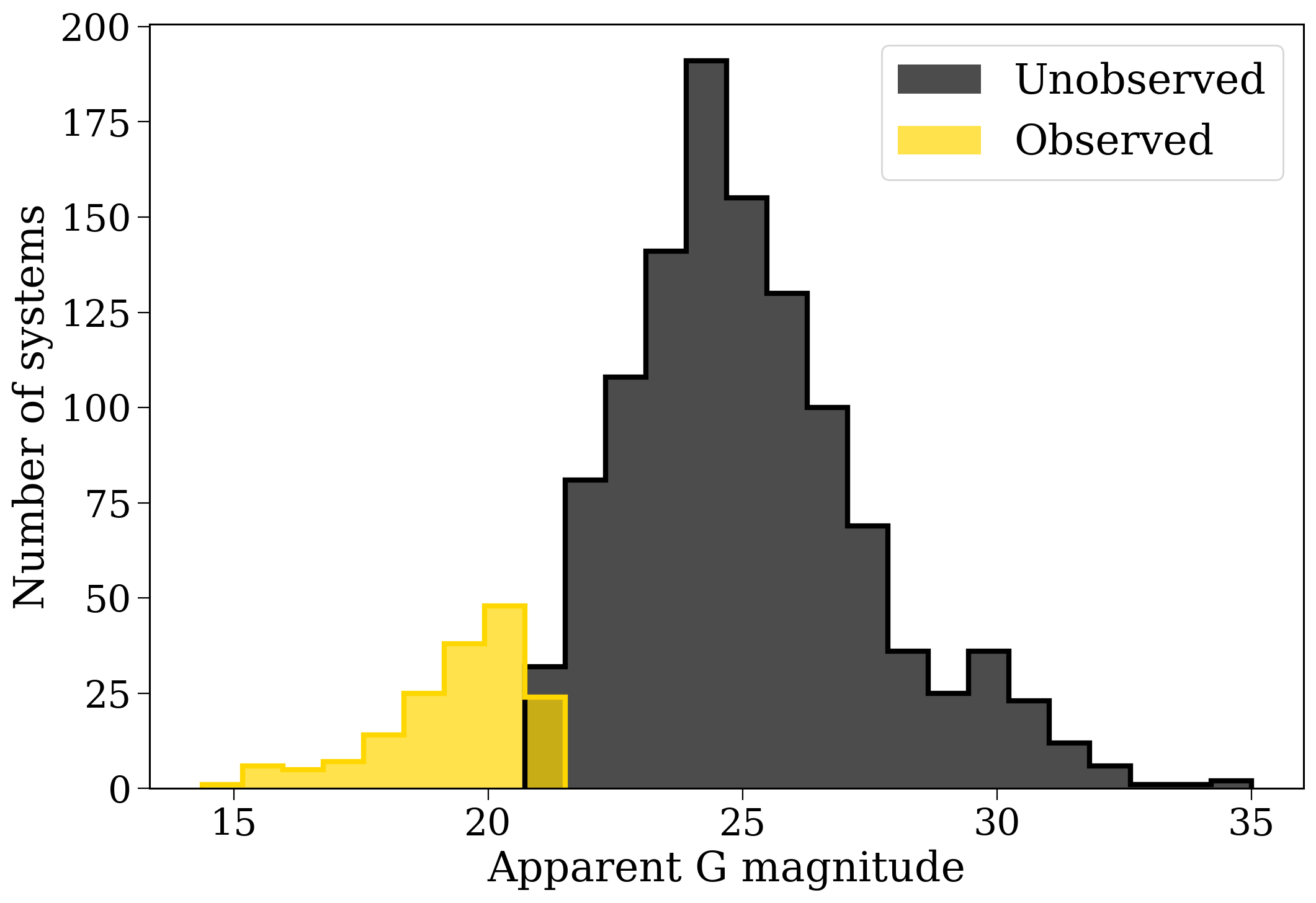
Let’s take a look at how the G magnitudes of the observed systems are different from those that aren’t observed.
[5]:
obs_Gs = np.concatenate(
    (p.observables.loc[bound_prim_obs_nums]["Gaia_G_EDR3_app_1"].values,
     p.observables.loc[sec_obs_nums]["Gaia_G_EDR3_app_2"].values)
)
unobs_Gs = np.concatenate(
    (p.observables.loc[~p.observables.index.isin(bound_prim_obs_nums)]["Gaia_G_EDR3_app_1"].values,
     p.observables.loc[~p.observables.index.isin(sec_obs_nums)]["Gaia_G_EDR3_app_2"].values)
)
[6]:
fig, ax = plt.subplots()

bins = np.linspace(12, 35, 30)
for G, colour, label in zip([unobs_Gs, obs_Gs],
                            ["black", "gold"],
                            ["Unobserved", "Observed"]):
    G = G[np.isfinite(G)]
    ax.hist(G, bins=bins[(bins > min(G) - 1) & (bins < max(G) + 1)],
            color=colour, alpha=0.7, label=label);
    ax.hist(G, bins=bins[(bins > min(G) - 1) & (bins < max(G) + 1)],
            color=colour, histtype="step", lw=3);
ax.legend()
ax.set(xlabel="Apparent G magnitude", ylabel="Number of systems")
plt.show()
[7]:
f'Faintest observed magnitude: {obs_Gs.max():1.2f}'
[7]:
'Faintest observed magnitude: 21.28'
[8]:
f'Brightest unobserved magnitude: {unobs_Gs[~np.isnan(unobs_Gs)].min():1.2f}'
[8]:
'Brightest unobserved magnitude: 20.94'
So, as one might guess, the observed systems are in general much brighter (lower magnitude). However, we can see that there are systems brighter than the faintest observed system that were NOT observed - this is exactly the idea we were discussing before where you position on the sky affects the magnitude limit.
Wrap-up#
You should now know how to check the Gaia observability of your sources after that short little tutorial. Continue to the next tutorials to learn more about visualising your results with cogsworth!
Note
This tutorial was generated from a Jupyter notebook that can be found here.